

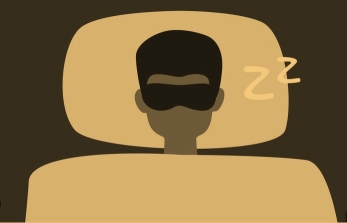
Every night we perform an act that may be mysterious but is fantastic, and we don’t even realize it. We lie down, close our eyes and then disappear. It is not the body, nor the breath, but we — the one who thinks, who worries, who plans and who remembers — simply disappears. But we have no idea where we are going.
Tonight, when you surrender to sleep, you will dissolve into something profound, and beyond everyday comprehension. But we have been conditioned to treat this daily “death” and “resurrection” as something banal. When it is actually an extraordinary journey that happens to us every night. However, we can go a lifetime without realizing what is really happening when we go to sleep.
Every night, if we want to get into a more dramatic perspective, we practice something that amounts to a kind of “voluntary suicide.” For what we call the “I” – this inner speaker who thinks, who feels, who experiences and who exists – voluntarily enters into an absolute forgetfulness of itself.
We are so used to this nocturnal disappearance that we miss the question of how extraordinary it is. Thoughts stop, the sense of time evaporates, our identity — all the opinions, memories, and worries we cling to so tightly — dissolve completely. And yet, in some deep way, there is something behind it that is always present.
It is something that is not the “me”, but it is not the “not-me” either. It is as if every night we go to a kind of emptying of the self, an “emptiness” — the pure being that always remains in existence while the ego disappears.
Society teaches us to treat this daily “miracle” as if it were just a kind of maintenance, a battery charge, the restart of the computer or a machine. Thus, thinking in this way, the result will always be something trivialized.
Let us now look more closely. What exactly disappears when we fall asleep?
Our name no longer matters. Our work, our relationships, our endless to-do lists—everything disappears. Everything that we think defines us simply ceases to be present.
That person who is worried about the next morning’s meeting, who remembers yesterday’s conversation, who has political views or has certain preferences about coffee — all that construction stops completely.
It is the most absolute oblivion. And we do not live it with the perception or feeling of loss or death. For there is no tragedy in deep sleep, there is no mourning for the “I” that is going to disappear. Why?
Because that “I” that could complain has disappeared.
Every night we prove that we exist perfectly well without being who we think we are.
We can say that we exist in a purer and more essential form, when all psychological burden is removed. But this raises a question:
If we manage to exist and live without our identity every night, what does that tell us about that “identity-self” that we defend with so much zeal during the day?
During the waking state, there is always the feeling that there is a “me” watching, isn’t there? An observer behind the eyes, a constant witness of thoughts, a presence. Let us call it Consciousness. This observer seems so persistent, constant and reliable that we never question his permanence. In such a way that, when he reaches sleep, he maintains himself and witnesses his quality in the next wakefulness.
When sleep comes, the “I“ calms down and disappears, but Consciousness remains. Because when we wake up from a deep sleep there is the notion that we have existed during sleep. In other words, there is always the perception that this sleep has gone well or badly when you wake up. And this can only happen when there is a perception that we have existed as consciousness during that period of sleep.
In dreams there is a perception of identity; But what “I” is this that creates extraordinary “films”?! Who is this “I” who writes the script of dreams?! And what “I” creates the characters in this film?!
In dreams, this “I” visits unknown places, talks to unknown people, lives stories with astonishing richness and detail. This “I” creates worlds, with laws, relationships and narratives as convincing as a Hollywood production. And there is the full realization that they are real until you wake up.
If this “I“ can create such convincing realities when the “waking self“ is not present, how can we be sure that what we call the waking state is not just another kind of “me“ in another kind of dream state?
When we talk about the state of deep sleep, where there are no thoughts, no images, no time, no space, no perception of “I”. However, as mentioned earlier, there is the perception of existence.
In deep sleep, we exist without a “me” to experience or observe. There is a Consciousness without objects. It is an “I am” without attributes, without qualities, without identity. It is pure consciousness of existence.
We visit this state of deep sleep, of a kind of “peace” every night. What we seek in meditation, philosophy, and religion, in fact, we live naturally whenever we fall asleep.
Consciousness does not need the “I” to exist. This “I” that creates identity disappears into deep sleep, but Consciousness remains unchanged.
There is no separate “me” that has consciousness. There is a dreaming “me” that is someone separate. Just as the wave is not separated from the ocean — it is actually the ocean expressing itself as a wave.
Every night we return home.
When you wake up in the morning, observe: first there is only pure Consciousness. Then, slowly, the “I” appears. The name, the life story, the concerns. But who creates all this?
The same Intelligence that makes the heart beat, that makes hair grow, that transforms a seed into a flower. None of this happens only at night. It’s happening now. The only difference is that when awake, there is the illusion that someone is in control, as the ego takes over.
If we ask ourselves and observe ourselves: who chose the thought that has just arisen? Who decides when we fall in love? Who controls the immune system?
The waking state is just another dream—as convincing as the dreamer who forgets that he is dreaming. That which really Is, Is that which remains when all dreams end.
So when you go to bed tonight, recognize that you will return to your true nature. And when you awaken, stay for a moment in that Presence, before you become someone or something again.
Consciousness is not something we possess or to possess.
The deepest spiritual realization is what we live every night and forget every morning. But now that you know this — and knowing it — how can you face these dreams of being someone so seriously again?
a student